
The Role of AI in Exhibit Design
Based on data from The Experiential Design Authority's 2026 survey. By Travis Stanton
Artificial intelligence is no longer a fringe experiment reserved for Silicon Valley labs or sci-fi think pieces. It is actively reshaping industries that once seemed immune to automation, creative fields included. Architecture firms are using generative design tools to explore thousands of structural options in minutes. Fashion brands are testing AI-generated collections. Filmmakers are de-aging actors, resurrecting dead voices, and storyboarding scenes with synthetic talent.
And now the exhibit industry is asking the same question everyone else is: Is AI a tool, a threat, or something in between? To find out, The Experiential Design Authority surveyed exhibit designers, producers, and manufacturers about how — and whether — they are incorporating AI into the exhibit design process. The results reveal an industry that is curious, cautious, and far from consensus.
Who's Using It and Who Isn't
According to TEDA's survey, 59 percent of respondents say they currently use AI during the exhibit design process, while 41 percent do not. That split that we’re still feeling our way forward — neither fully committed nor wholly resistant.

Among those using AI, the adoption is notably divided between levels of engagement. Roughly half describe their usage as "light" (turning to AI only for specific tasks and only when other approaches have been exhausted). The other half describes "moderate" usage (reaching for AI regularly when the need arises). Notably, not a single respondent described their AI usage as "heavy" or pervasive. This is still a tool people are learning to trust, not one they've handed the wheel to.
What's Driving Adoption
For those embracing AI, the reasons are mostly creative rather than operational. Over half of respondents cited heightened creativity and improved ideation as the primary benefit, suggesting that designers are turning to AI not to replace their thinking but to expand it. Increased efficiency followed at 31 percent, with shortened project timelines noted by about one in five.
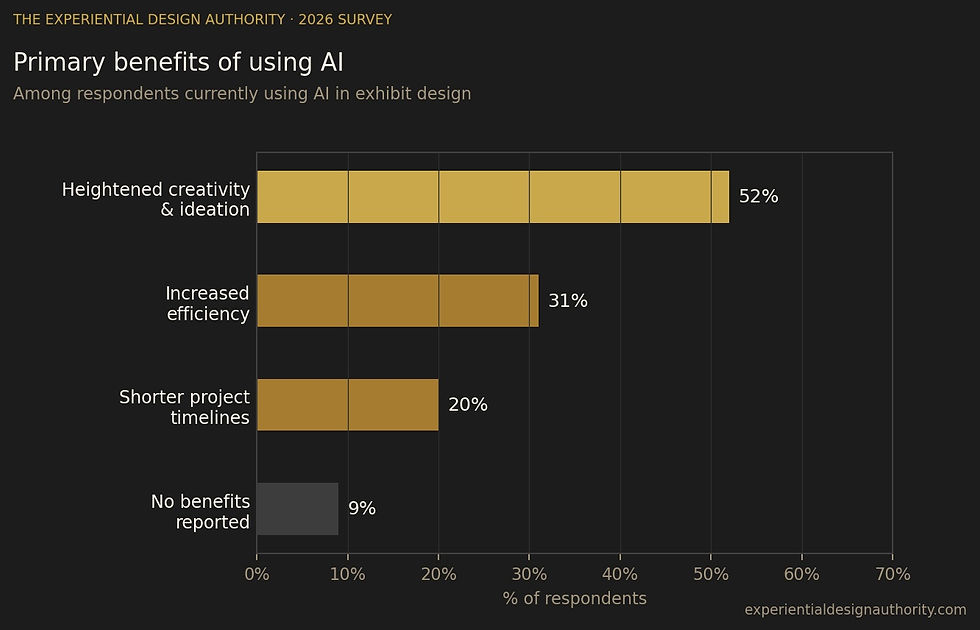
Only a small handful reported seeing no benefits at all, which is perhaps the most telling data point: Most people who try AI in the design context don't hate it. They just aren't sure how far to trust it.
"We occasionally use AI during the concept phase to get more ideas or help visualize ideas," said Casey Baron, Senior Director of Creative at Storylink Creative. "But I fear designers are beginning to rely too heavily on AI as the final creative execution. While AI can be a powerful tool for ideation, it should never replace human intuition or our ability to think differently about how an audience truly experiences a design."
That sentiment — AI as an early-stage creative partner, not a final authority — echoes throughout the data.
AI Beyond the Design Department
While exhibit-specific adoption remains split, the industry's comfort with AI in other areas is notably higher. According to the survey, 69 percent of respondents say their organizations already use AI for non-design purposes. Marketing and sales is the most common application, cited by 46 percent of respondents, followed closely by client communications at 48 percent. Finally, 31 percent use AI for project management purposes.

In other words, resistance to AI isn't ideological. It's contextual. Many firms are comfortable with AI handling proposals, social posts, and scheduling — they're just not ready to let it touch the design.
What's Holding the Others Back
Among the 41 percent not using AI in their exhibit design work, the objections vary widely, and some are more principled than practical.
Kristof Van Leughenhagen, owner and designer at Standideas, put it plainly: "I became a designer to design, not to type prompts. Every brief is different, so every design is unique. In my opinion, if you don't have inspiration, you don't have the experience."
Others pointed to feasibility concerns. Jeff Kisko of Octanorm noted that AI-generated concepts can create unrealistic expectations: "It will sometimes produce ideas that are not feasible. If a customer sees this, it may lead to confusion or frustration." That concern is already playing out. Several respondents noted clients arriving with AI-generated booth concepts in their RFPs, including designs that look compelling on screen but collapse under the weight of real budgets, rigging restrictions, union labor rules, or the basic laws of physics.
Wendi Jacobs of Acer Exhibits raised a concern that cuts even deeper: "The creativity of our designs is one of the foundations of our business. I'd hate to see that lose value to clients who think they can create a design with AI and expect us to build it." She added: "Just like a chatbot can't fully replace a human conversation, I don't think AI design can replace human design. Assist it, yes. Do the whole job? No."
The Confidence Gap
When TEDA asked respondents how confident they are in their company's understanding of AI tools and their potential benefits, the results painted a telling portrait of an industry navigating unfamiliar terrain.

Review those numbers carefully. Only about one in sixteen respondents described themselves as "very confident," meaning they know what tools to use, how to use them, and what's coming next. The largest single group is confident but not cutting-edge. Nearly four in 10 acknowledge they're struggling to keep pace. And roughly one in 16 admits they don't know where to start.
This matters because it reframes the adoption debate. The 41 percent of the industry not currently using AI in their design work aren't necessarily resistant to it. Many of them simply feel unequipped. That's a very different problem, and it points toward a different solution: not persuasion, but education. The industry doesn't need more arguments for why AI is valuable. It may need better on-ramps for the majority who aren't sure how to begin.
How It's Actually Being Used
Among the firms that have adopted AI, the applications tend to be targeted rather than sweeping. Ideation and mood boards are the most common entry points, using AI to visualize aesthetic directions, explore color palettes, and generate starting points for client conversations.
Steve Deckel, CEO of Deckel & Moneypenny, is more surgical: his firm uses Topaz Gigapixel AI to enhance low-resolution client-supplied imagery, and Gemini to convert still images into short motion graphics. "AI can help once you know the creative direction," Deckel explained, "but it seldom recommends a solution we would recommend. Our job is to communicate in an unexpectedly charming way, not the obvious, predictable way. And just as great jokes don't work once they've been diagrammed, design is difficult to quantify and explain."
One anonymous respondent described a more integrated approach: "AI enables us to generate initial concepts, layouts, and visualizations faster, allowing us to explore more design options in less time and support better-informed client decisions. It also helps automate repetitive tasks and supports technical checks. By using AI to review brand and construction guidelines, we can interpret and apply requirements more consistently, ensuring designs meet both brand standards and technical feasibility before production."
The Disclosure Problem
Perhaps the most revealing finding in the survey isn't about usage — it's about transparency. Just 11 percent of respondents say they always disclose AI usage to clients proactively. Another 34 percent do so only if asked. Ten percent say they never disclose it at all.
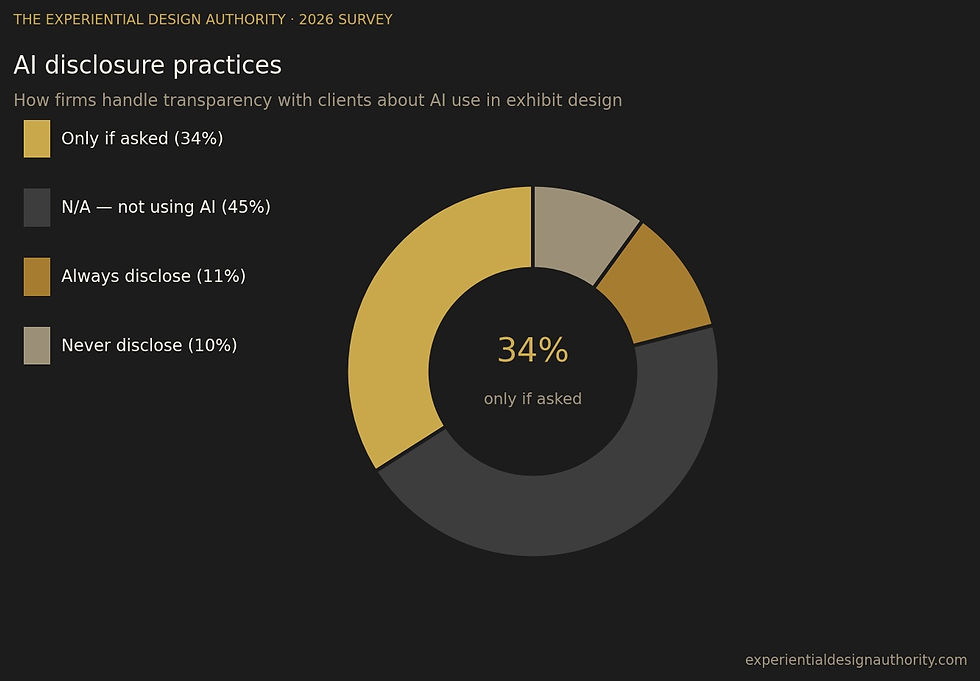
That means a significant portion of the industry is already using AI in client work without telling anyone — not out of malice, but out of uncertainty. When you're unsure how a client will react, silence feels safer than explanation.
That ambiguity extends to firms' own perceptions of their clients. A full 39 percent of respondents say they don't know how their clients feel about AI use in exhibit design. Only 15 percent report that clients actively encourage or support it, while another 8 percent say clients discourage or prohibit it outright. The overwhelming middle is indifference: the largest single client sentiment, cited by respondents, was simply not caring one way or the other.
Privacy and Intellectual Property
One of the most substantive concerns raised in open-ended survey responses centered not on creativity or craft, but on data security. As one respondent put it: "When using AI tools to generate visuals or concepts, there is often uncertainty about what happens to the data you upload. When entering client names, brand assets, logos, or confidential project details, it is not always clear whether this information is stored, reused for training, or exposed outside the project environment. This raises questions about confidentiality and client trust."
This concern is legitimate, underreported, and likely to grow. The question of what happens to a client's proprietary information once it enters an AI platform — even briefly — is one the industry hasn't fully reckoned with.
What People Actually Believe About the Future
When asked to look ahead, survey respondents are almost evenly split between two camps. Forty-eight percent believe AI is a trend, powerful for some, unnecessary for others, but not a universal imperative. Forty-four percent say it's the future and everyone will use it eventually. Only a small minority dismiss it as a fad.
The liability question is similarly unsettled. Only 15 percent of respondents believe it is currently a liability for an exhibit provider to not use AI. Another 39 percent say maybe. Thirty-one percent say it's still too early to make that call. And notably, one respondent flipped the question entirely, noting that they believe AI is itself the liability.
Where This Leaves Us
The honest picture that emerges from this survey is of an industry in transition — curious enough to experiment, cautious enough to hesitate, and divided enough that no single consensus has formed.
What's clear is that the firms already using AI are largely doing so as a creative accelerator, with AI at the front of the process, humans at the back. The firms holding back are doing so for reasons that deserve respect: concerns about craft, feasibility, client perception, and intellectual property that aren't going away just because the tools are improving.
The most realistic near-term future for AI in exhibit design is probably not a revolution but an evolution. AI will likely continue to handle work that benefits most from scale and speed (ideation, visualization, iteration, repetitive production tasks), while human designers retain authority over the decisions that require judgment, context, and the kind of unexpected creative thinking that no algorithm has yet learned to replicate.
As one respondent said: "These are exciting times for AI, but it's important to be mindful of relying on it for the entire design process without independent thought." That may be the most useful framing the industry has produced so far.
Tools of the Trade
When TEDA asked respondents to name the specific AI tools and platforms they use, the list ranged from industry-specific applications to general-purpose AI assistants. Here's what the industry is actually reaching for:
For ideation and image generation
ChatGPT/OpenAI is the most widely cited tool across respondents, used for brainstorming, copywriting, and concept development.
Midjourney is used, primarily, to generate images for mood boards and visual exploration.
Adobe Firefly integrates AI image generation directly into existing Adobe workflows.
Canva AI is cited for providing design assistance within the Canva platform.
Mashy AI facilitates generative design and visualization.
Motion Array creates AI-assisted video and motion graphics.
Gemini can convert still images into short motion graphics and is also used for general ideation.
For rendering and production
Topaz Gigapixel AI is used for upscaling and enhancing low-resolution client-supplied imagery.
WellSaid is an AI voice-over generator often used for video content.
Google AI/Google AI Genesis helps in research, drafting, and content generation.
Octanorm AI Booth Designer is a system-specific exhibit design concept generation tool.
For communications and workflow
Microsoft Copilot integrates AI assistance across Microsoft Office tools.
Notion AI facilitates project documentation and knowledge management.
Otter Notetaker is cited as a solid AI-powered meeting transcription tool.
Clay can be used for AI-assisted client relationship and outreach management.
Grok is a generative AI chatbot for research and ideation.
The Experiential Design Authority's survey on the role of AI in exhibit design was conducted among exhibit designers, producers, and manufacturers. For more information about TEDA, visit experientialdesignauthority.com.
Comments